Pinecrest · 8 min read
Pinecrest Landscape Design: Designing Large Residential Gardens
Pinecrest is known for generous residential lots, often with mature trees and room for a pool, lawns and several outdoor spaces. That scale is a great opportunity — and a common source of disappointment.
A large garden should not simply contain more things. It needs stronger structure.
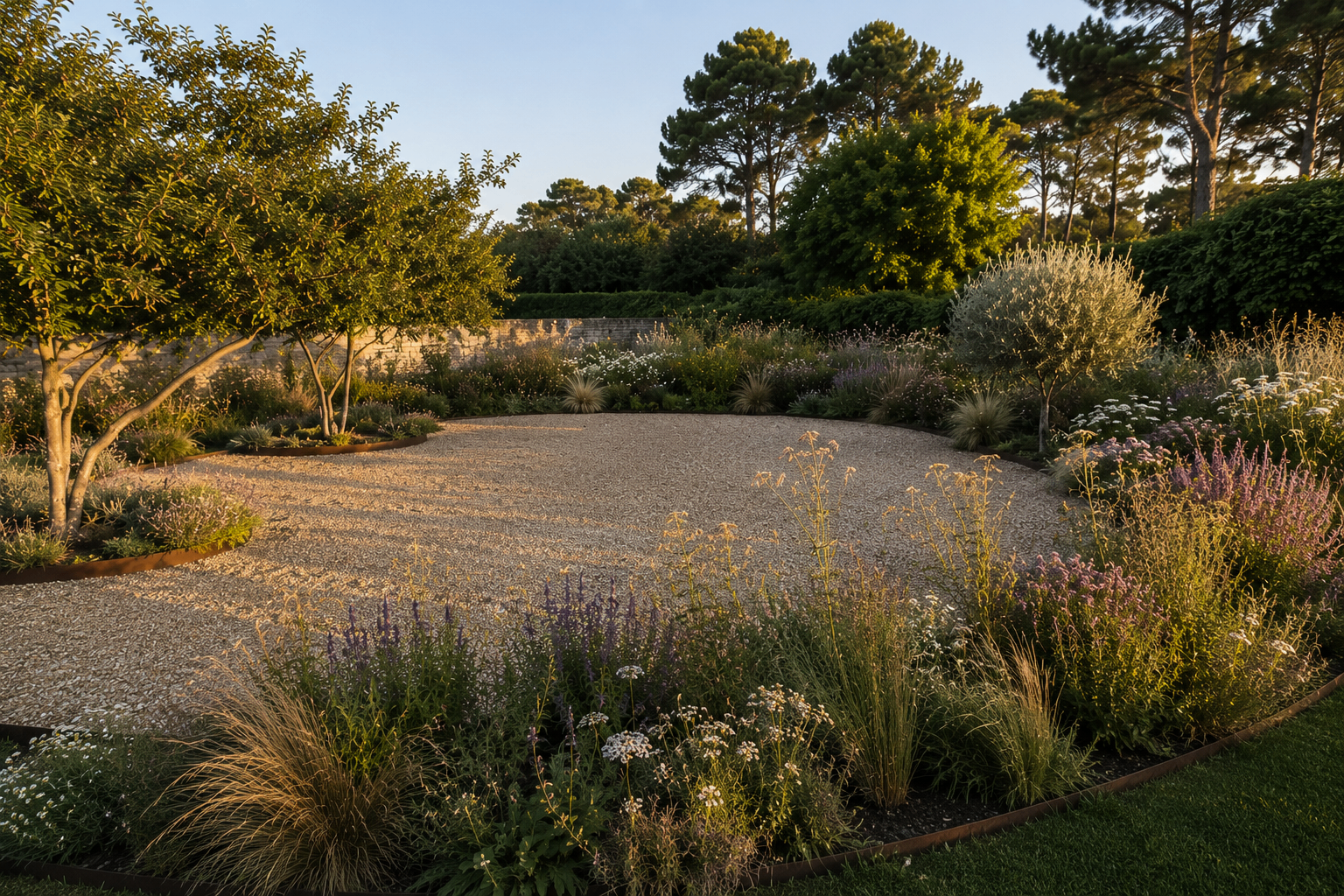
Nistal Landscape Design portfolio, Spain.
Masterplan first, plants later
On a large property, the most important decisions are made long before choosing individual plants. Where are the main spaces? How do they connect? What is seen from the house? Where will shade be needed in ten years?
A clear masterplan sets out these relationships. It also allows a project to be built in phases without losing coherence — something many owners of large gardens appreciate.
Create hierarchy
Not every part of a large garden should receive the same attention. Some areas are primary — the terrace off the main living spaces, the pool, the arrival. Others are secondary or deliberately quiet.
Hierarchy gives the eye somewhere to rest and makes the important spaces feel special. Without it, a large garden becomes a series of similar areas competing with one another.
Arrival and the driveway
On bigger lots the driveway can be long, and it is a real part of the landscape. Trees planted along it, a change of paving near the house and a considered point of arrival turn a functional route into a sequence.
The goal is for the house to be revealed gradually, with the garden announcing its character before the front door is reached.
Views from the house
Much of a garden is experienced from inside. We map the main views from living rooms, kitchen and bedrooms and use them to position trees, openings and focal points. A garden designed from the windows out feels intentional in every season.
Lawn or planting?
Large lawns are easy to imagine and hard to make interesting. Open grass is valuable for play and for the sense of space it creates, but too much of it can make a property feel empty.
A good balance usually combines a defined lawn with generous planted areas at its edges, giving the open space a clear shape and a sense of enclosure.
Trees establish scale
On a large site, trees are the elements that relate the garden to the house and to the surroundings. Groups of trees, rather than isolated specimens, create structure and shade at the right scale.
Trees also need time. Choosing their position carefully, and allowing enough space for the canopy and roots to develop, is one of the most lasting decisions in the project. Species and spacing have to suit South Florida’s subtropical climate.
A garden of outdoor rooms
Large properties can hold several distinct spaces, each with its own purpose and atmosphere.
The pool landscape
The pool is often the center of outdoor life. Its position relative to the house, sun and shade, and the terraces around it should be defined early. We discuss these choices in our article on pool landscape design in Miami.
Dining and entertaining
An outdoor dining area close to the kitchen, under shade, with space for larger gatherings, is often the most used part of the garden.
Secondary seating
Quieter places further from the house — a bench under a tree, a small terrace at the end of a path — give the garden depth and reasons to walk through it.
Screening and privacy
Even on large lots, neighboring houses and roads can be visible. Layered planting at boundaries screens views while keeping the garden open inside. Screening should be concentrated where it is needed, not applied uniformly around the whole perimeter.
Connecting the whole
The common problem with large gardens is fragmentation: areas designed one by one, each with different materials and plants. Repeating a small palette of materials and key plants across the property ties everything together.
The same stone at the terrace and along a path, the same tree species at the arrival and at the far end of the garden: repetition makes a large space feel coherent.
Designing for 5, 10 and 20 years
A large garden changes significantly as it matures. After five years, planting has filled out; after ten, trees begin to shape shade and views; after twenty, the canopy defines the garden.
Planning for these stages avoids overcrowding and ensures that the garden becomes more beautiful over time. It also informs maintenance, which on a large property is part of the design, not an afterthought.
Technical coordination
Drainage, irrigation and lighting become more complex with scale. Levels and water flow across a large site, efficient irrigation zones and a lighting plan that highlights key elements without overlighting all need to be integrated into the design.
We coordinate these aspects with local engineers, contractors and specialists, whose knowledge of the site and regulations is essential.
Balancing architecture and landscape
On a large property, the garden can easily overpower the house or feel disconnected from it. The terraces and spaces closest to the building should follow its architecture; the landscape can then become gradually freer further away.
This gradient from architectural to natural is one of the principles we apply in all our residential landscape design across Miami and South Florida.